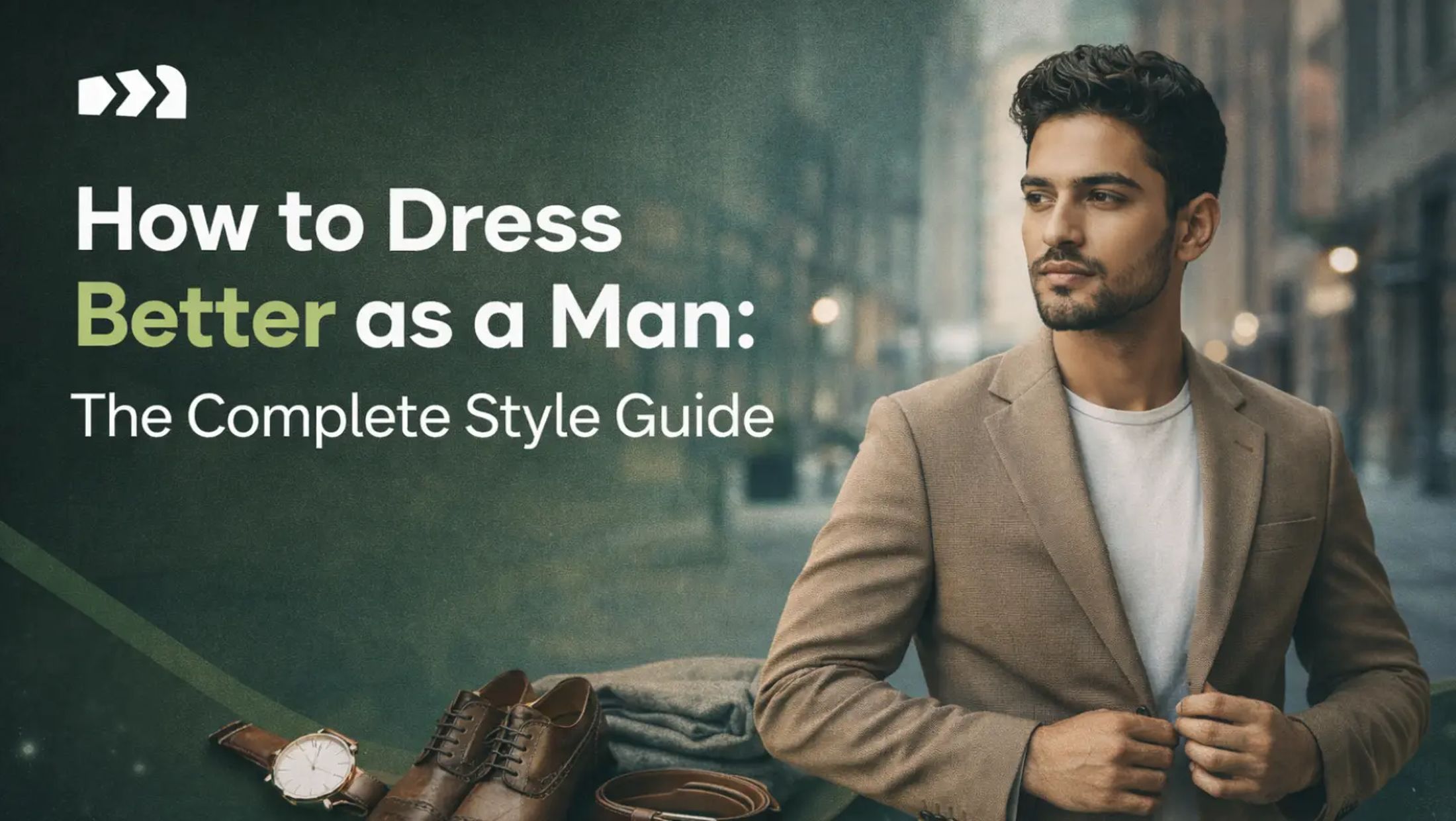
Understanding how to dress better as a man is not about following trends or rebuilding your wardrobe from scratch. It is about understanding why some men always look perfect for the occasion and others, despite spending more money on more clothes, consistently do not. The difference is almost never the budget. It is always the knowledge.
This men's style guide covers everything a man needs to move from a wardrobe that feels like an afterthought to one that works reliably across every situation he faces. How to build a capsule wardrobe men will actually use. How to understand smart casual properly. How to dress for your body type. What to wear on a first date. Style tips for men who are starting from scratch and men who already have the basics but cannot get them to work together.
Style is not something you either have or you do not. It is a skill. And like any skill, it becomes straightforward once the actual rules are explained clearly rather than buried under vague advice about finding your personal aesthetic.
Work through this guide once and you will have a clearer picture of how to dress well as a man than most men develop across years of guessing.
Why the Way You Dress Matters More Than Most Men Admit
Before getting into the practical guidance, it is worth addressing the question some men raise at the start of any conversation about style, which is whether any of this actually matters in the first place. It does. And the evidence is not subtle.
Research in social psychology consistently shows that people form rapid impressions of others based on appearance before a single word is exchanged. These impressions are not always fair and they are not always accurate. But they are real and they carry real consequences in job interviews, first meetings, social gatherings, and any situation where another person is forming an initial read of who you are.
Beyond how others perceive you there is the effect that clothing has on how you perceive yourself. Psychologists refer to this as enclothed cognition, the documented phenomenon where the clothes a person wears influence their own cognitive performance and emotional state. Men who dress with intention consistently report higher levels of confidence, greater ease in social situations, and a clearer sense of presence in high-stakes interactions.
This is not about vanity. It is about recognising that clothing is a form of communication and that, like every other form of communication, it is worth doing with some deliberateness rather than by default.
How to look more attractive as a man and how to look more confident are not separate questions with different answers. They both begin in the same place, with a clear and honest understanding of what you are wearing and why you are wearing it.
The Three Principles That Underpin All Good Menswear
Every man who consistently looks well dressed understands three things that most men do not. These are not rules about which brands to buy or which trends to follow. They are foundational principles that, once understood, make almost every style decision significantly easier and more reliable.
Fit Is the Variable That Matters Most
A well-fitted garment from an ordinary brand will always look better than an expensive piece that does not fit the body wearing it. This is the single most important rule in all of men's style and the one most consistently ignored.
Fit means the shoulder seam of a jacket sits at the edge of your actual shoulder. It means a shirt does not pull across the chest or hang loose at the sides. It means trouser legs break cleanly at the ankle without bunching or sitting high on the calf. It means the clothing follows the shape of your body without constricting it.
Most men buy clothing in their assumed size and wear it regardless of how it actually fits on their specific body. The habit of trying things on properly, assessing them critically, and only keeping what genuinely fits is the single highest-return change any man can make in how he dresses. A basic local tailor can adjust the fit of almost any garment for a modest cost. That small investment delivers more visible improvement than buying better brands will ever produce on its own.
Neutral Colours Give You the Most Versatility for the Least Effort
Men who always appear put together are almost universally working from a wardrobe anchored in neutral tones. Navy, white, grey, black, camel, and olive are the foundation that allows a wardrobe to function as a system rather than a collection of individual pieces that may or may not work together on any given morning.
This is not a recommendation to dress without personality. It is a structural observation about how wardrobes work. When the majority of what you own is built on neutral colours, any individual piece pairs with almost everything else without effort. The daily friction of trying to combine things that clash is eliminated. The number of decisions the morning demands is reduced to almost nothing.
Colour, pattern, and texture can be introduced gradually once the neutral base is established. One or two pieces that carry a stronger visual character become genuinely interesting when set against a calm, considered backdrop rather than competing with other strong elements for attention.
Quality in a Few Key Pieces Outperforms Quantity Across the Whole Wardrobe
A wardrobe of well-made pieces in quality fabrics costs less over time than a wardrobe of cheap clothing replaced frequently. Poorly made garments lose their shape, fade, pill, and wear through quickly. Quality fabrics and construction hold across years of regular use.
The practical application of this is to identify the pieces you reach for most often and invest meaningfully in those specifically. The jacket worn twice a week, the white shirt that covers every meeting, the trouser that goes everywhere. Everything else can be moderate. Directing quality investment toward the highest-frequency, highest-visibility pieces is how men build wardrobes that perform well year after year rather than deteriorating season by season.
How to Build a Capsule Wardrobe Men Will Actually Use
A capsule wardrobe is a deliberately chosen set of versatile pieces that work together across a wide range of situations. For men, the goal is a wardrobe where every item earns its place, nothing sits unworn for months, and getting dressed for any occasion requires minutes rather than producing a low-level sense of dread.
Building one requires making honest decisions about what your actual life requires rather than what looks appealing on someone else in an edited photograph.
Wardrobe Essentials Men Should Own Before Anything Else
Start with the pieces that do the most work across the widest range of situations. These are the wardrobe essentials men actually reach for consistently, not the aspirational pieces that live on hangers and accumulate guilt.
A well-fitted white shirt in quality cotton is the most versatile single garment in men's clothing. It works under a jacket for professional contexts, on its own for smart casual situations, and open over a plain t-shirt as a layered casual look. One white shirt that fits correctly covers more occasions than five that do not.
Dark, straight-cut denim in a clean wash with no visible distressing is the second most useful piece. It reads casual with a t-shirt and clean sneakers and reads smart casual with a white shirt and a leather shoe. Most men already own jeans. Most men do not own a version that fits well enough to actually do this job.
A plain crewneck or V-neck knit in navy or grey is the third essential. Not a branded sweatshirt, not a hoodie, but a clean simple knit that layers over a shirt collar or wears alone with equal ease. It adds warmth and texture without requiring any thought.
A single well-fitted blazer in navy or charcoal is the piece that solves the most getting-dressed problems. Not a suit jacket, but a standalone blazer that can be worn with jeans and a white shirt to cover every situation that sits between fully casual and formally dressed. This one garment bridges more occasions than almost anything else a man can own.
One quality pair of leather or leather-look shoes in brown or tan and one pair of clean minimal white sneakers cover the footwear requirements for everything the rest of this wardrobe needs. Most men own significantly more shoes than this and use fewer of them regularly.
If you want personalised guidance building a wardrobe that works specifically for your body type and lifestyle, working with a style coach removes years of trial and error from the process.
Smart Casual Men: The Dress Code That Covers Most of Your Life
Smart casual appears more frequently in modern men's lives than any other dress code and causes more confusion than all the others combined. It sits between formal and fully relaxed, which means men default to one extreme or the other and get it wrong in either direction.
Understanding it properly gives you access to a single formula that covers work environments, social dinners, first dates, networking events, and almost every occasion that does not specify black tie or active wear.
What Smart Casual Actually Means
Smart casual sits between business casual and fully casual. It means you have made a visible and considered effort without crossing into formality. The clothes are clean, well-fitted, and free of heavy branding or graphics. They are put together without being stiff.
The simplest way to think about smart casual for men is to take a casual piece and elevate it or take a formal piece and relax it. Dark jeans with a white shirt and a clean leather shoe is smart casual. Tailored chinos with a fitted knit and a chelsea boot is smart casual. A blazer worn over a plain t-shirt with dark jeans and a leather-look sneaker is smart casual. Each combination works because it pairs something relaxed with something considered.
What smart casual is not: branded trainers, graphic t-shirts, cargo shorts, heavily distressed denim, hoodies worn as the main layer, or anything that reads as exercise or errand clothing. These pieces pull the outfit back into casual territory regardless of what else surrounds them.
Smart Casual Mens Outfit Ideas for Every Common Situation
For a work setting that does not require a suit: dark chinos, a well-fitted white or pale blue shirt with the top button left open, a navy blazer, and a tan leather shoe or clean leather chelsea boot. This combination reads as professional without appearing stiff and works in any office environment that does not mandate formal dress.
For a social dinner or casual evening date: dark jeans in a clean wash, a simple well-fitted knit or button-down shirt in a neutral colour, and a leather shoe or clean white sneaker depending on the venue. This is the smart casual combination most men get the most mileage from because it is genuinely versatile across seasons with only minor adjustments in layering.
For a networking event or professional gathering: the blazer over jeans combination is consistently the right call. A fitted blazer in navy or grey over dark jeans, a white shirt or clean t-shirt underneath, and a leather shoe elevates the outfit enough to signal that you are taking the occasion seriously without making you appear overdressed in a room where others are also in smart casual.
The thread that runs through all three is that fit, colour discipline, and shoe choice do most of the work. The garments themselves are simple. What makes them function as an outfit is how well they fit and how cleanly they combine with each other.
If you want to explore coaches who specialise in style, confidence, and personal presentation all in one place, the coaches hub gives you a full view of who is available and what they cover.
How to Dress for Your Body Type as a Man
Fit is the most important principle in men's style and fit is not a fixed concept. What fits and flatters depends entirely on the shape of the body underneath the clothing. Understanding how to dress for your body type is what separates men who look good reliably from men who only look good when someone else picks the outfit.
If You Have a Lean or Slim Build
The most common mistake slim men make is buying clothing that is too large in an attempt to create the appearance of more physical bulk. This has the opposite effect. Oversized clothing on a lean frame reads as poorly fitted rather than relaxed and draws attention to how slight the body underneath actually is.
The correct approach is clothing that is fitted without being tight. Slim or straight-cut trousers rather than relaxed fits. Shirts that sit close to the body without pulling at the chest. Layers create visual depth and dimension in a way that a single loose garment never does. A shirt under a knit under a structured jacket creates layered substance that adds visual weight without relying on the body to provide it.
Horizontal stripes, textured fabrics, and structured outerwear all add visual width. A well-fitted overcoat is particularly effective on a lean frame because the structure of the coat creates a broad, considered silhouette that reads as intentional rather than slight.
If You Are Broader or Carry More Weight
The goal for broader men is to create clean vertical lines that draw the eye up and down rather than across. A jacket or blazer that sits correctly at the shoulders and does not pull across the back immediately improves the silhouette of almost any man carrying more weight, regardless of the specific garments underneath.
Dark colours on the lower half of an outfit visually recede and reduce apparent width. Lighter tones and horizontal patterns on the upper half draw the eye upward and should be used selectively. The strongest versions of this principle are monochromatic outfits where both halves are in the same or similar tones, creating a continuous vertical line that is consistently flattering regardless of body shape.
Avoid the instinct to size up significantly for comfort. Clothing that is noticeably larger than the body creates shapelessness that emphasises rather than reduces bulk. A moderate, structured fit in the correct size is almost always more flattering than something two sizes larger worn for comfort.
If You Are Shorter
Proportion is the primary consideration for shorter men and the key is to avoid anything that creates a strong visual break between the upper and lower body. A tucked shirt in a contrasting colour to the trouser divides the silhouette horizontally and reduces perceived height. Monochromatic outfits in matching or closely related tones create a continuous vertical line that adds height visually without any other adjustment.
Trousers that sit at the natural waist rather than low on the hips, with a clean break at the ankle rather than significant pooling, lengthen the leg visually. Cropped jackets that end at the hip rather than below it also help by keeping the proportions from being cut short.
Oversized or very long outerwear that drops to the knee or below shortens the apparent height of any man wearing it. A coat that ends at the mid-thigh works considerably better on a shorter frame. Minimal detailing and clean silhouettes consistently outperform busy or heavily textured looks.
Mens Outfit Ideas for the Situations That Come Up Most Often
The most useful style guidance is situationally specific rather than general. Here are the men's outfit ideas for the exact scenarios where men most consistently struggle to know what to wear.
What to Wear on a First Date
What to wear on a first date as a man comes down to one principle: show that you made an effort without looking like making an effort is unusual for you. Showing up in whatever you happened to be wearing signals that the occasion did not register as worth any thought. Overdressing to a degree that looks uncomfortable signals a different kind of problem.
The formula that works across the vast majority of first date contexts: dark jeans in a clean wash, a well-fitted shirt or smart knit in a neutral colour, a leather shoe or clean minimalist sneaker depending on the venue, and a jacket if the setting or weather calls for one. This combination hits the right note whether the date is a casual bar, a restaurant, or a walk with a coffee.
Pay particular attention to grooming and the condition of your shoes. Both are among the first things noticed and they communicate self-awareness and care more directly than any individual garment. Clean shoes, a recent haircut, and clothes that are pressed and in good condition will do more for a first date impression than a new outfit worn once that does not quite fit.
The confidence that comes from knowing you look right for the occasion is itself a significant part of the impression you make. It removes self-consciousness that would otherwise sit between you and the other person and occupy mental space that should be going toward the conversation.
Once the outfit is handled, how you open a conversation and sustain it from the first few minutes is the next thing that determines how a first impression actually lands.
What to Wear to a Networking Event or Professional Gathering
Networking events occupy the smart casual zone for most men and the blazer with jeans formula is the reliable default in almost every case. Navy or charcoal blazer, dark well-fitted jeans with no distressing, a white or pale blue shirt with the top button left open, and a leather shoe or clean leather chelsea boot.
This combination reads as professional and considered without the formality of a full suit, which can make you appear overdressed in a room where the majority of attendees are in smart casual. It signals that you are taking the occasion seriously without the rigidity that makes you harder to approach.
If the event is more formally professional, move to tailored chinos or a well-fitted wool trouser in place of the denim and fasten the shirt collar. The rest of the formula stays the same. This version of the outfit sits comfortably across any business casual or smart casual professional environment.
What to Wear at the Weekend Without Looking Like You Have Given Up
The weekend is where most men's style collapses. Without the structure that professional contexts impose, the default becomes tracksuit bottoms, an old t-shirt, and footwear that has seen better years. This is not a moral failing. But for men who are working deliberately on how they present themselves, weekend habits either support or gradually undermine everything else.
The weekend does not require formality. It requires consistency. A plain well-fitted t-shirt, straight-cut jeans in a clean wash, and clean white sneakers take no more time to put on than the alternative and produce an entirely different impression in any context where you encounter other people.
A casual overshirt, a simple well-fitted hoodie in a neutral colour, or a light jacket covers any layering that weekend situations require. None of these are complicated choices. The only requirement is that they fit correctly and are in good condition.
Style Tips for Men Who Are Starting From Zero
If your current wardrobe is a collection of things accumulated without much thought over a long period, the most useful thing you can do before buying anything new is to edit what already exists.
Go through everything you own and apply a simple three-part test to each piece. Does it fit well? Is it in good condition? Have you worn it in the last twelve months? Anything that fails on more than one of those counts does not belong in an active wardrobe. Remove it. What remains gives you a realistic picture of what you actually use, which tells you precisely what is missing rather than leaving you guessing.
Once you know what is genuinely missing, add deliberately. Buy the neutral pieces first. A well-fitted white shirt if you do not have one that fits. Dark jeans that actually sit correctly if yours do not. A navy blazer if you have nothing that bridges casual and smart. These three pieces solve more getting-dressed problems than any other combination of garments.
Buy one thing at a time and integrate it before buying the next. This is how wardrobes that function are built, not through large simultaneous purchases that arrive together and may or may not work with each other. One deliberate purchase worn repeatedly tells you more about what you actually need next than any amount of browsing ever will.
How to improve your style is at its core a process of subtraction first and addition second. Most men's wardrobes need less in them before the right additions can make any visible difference.
How Style and Confidence Feed Each Other
The relationship between how a man dresses and how he carries himself is not superficial. It is grounded in a real and documented feedback loop between external presentation and internal experience.
When a man dresses in a way he considers appropriate and well-executed for the situation he is entering, the low-level self-consciousness that would otherwise sit in the background disappears. That disappearance frees up cognitive and emotional energy that would otherwise go toward managing how he is coming across. What people on the outside then read as natural confidence is partly the result of that absence of internal friction.
This means that dressing consistently and intentionally does not just change how others see you. It changes how you move through situations. Men who dress with deliberateness report feeling more prepared, more present, and more willing to engage than when they have arrived at something they are already second-guessing.
The mindset behind dressing with intention connects directly to how a man approaches every other area of his life. The same self-awareness that produces good style decisions also produces better communication, better decision-making under pressure, and a more grounded sense of how to carry yourself in situations that matter.
When the thinking underneath the behaviour is working clearly, both the visible and invisible expressions of it tend to improve together. If overthinking and self-doubt are getting in the way of that kind of ease, addressing that pattern directly is one of the most practical things a man can do.
Final Thoughts
Knowing how to dress better as a man does not require a large budget, an interest in fashion, or a natural instinct that some men have and others do not. It requires understanding a small number of principles, applying them consistently, and building a wardrobe with intention rather than by accumulation.
Start with fit. Build a neutral foundation. Establish the capsule of wardrobe essentials men actually reach for. Understand the smart casual formula that covers the majority of your life. Dress for the body you have rather than a hypothetical version of it. Each step in this guide is practical, affordable, and more impactful in application than it sounds in description.
The way you dress is one of the clearest signals a man sends about how seriously he takes himself and the situations he steps into. That signal is available to any man willing to pay it a reasonable and consistent amount of attention.
If you want structured, personalised support taking your style further than a guide can take you on its own, Muse connects you with experienced style coaches who work specifically with men on how they dress, how they present themselves, and how those two things connect to confidence across every other area of life.